
On Saturday, July 25, 2026, the Dutch Flat Fire started in the marshlands west of American Canyon and burned 32.5 acres in a matter of hours. The American Canyon Police Department issued evacuation orders for Knightsbridge Way up to Chaucer Lane, and for Kensington Way between Northrup and Chaucer lanes. Meadow Bay Drive closed between Kimberly and Marla drives.
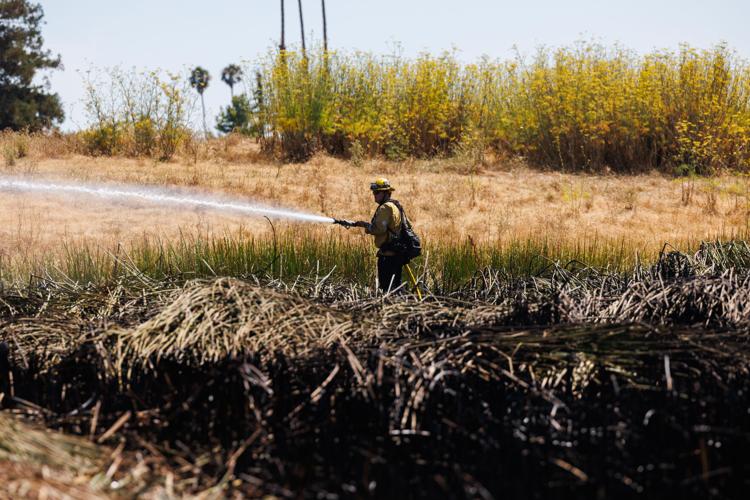
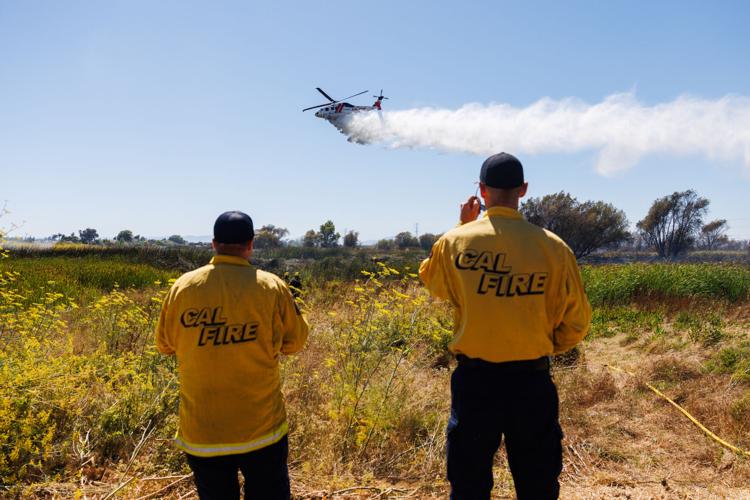
By mid-afternoon, with help from a CAL FIRE helicopter making water drops, firefighters had stopped forward progress. Evacuation orders lifted, Meadow Bay reopened at 5 p.m., and neighbors went home.
Thirty-two acres and no structures lost is the kind of outcome that does not stay in the news very long. It is worth a closer look anyway, for two reasons: the ground that fire moved across had been grazed and the fires that destroy California neighborhoods almost always begin exactly like this one.
What targeted grazing actually does
View the fire perimeter map next to the map of the targeted grazing and it’s impact is hard to miss. Below the red shading indicates the Dutch Flat fire perimeter and the green shading is the grazing that has been completed in this area.
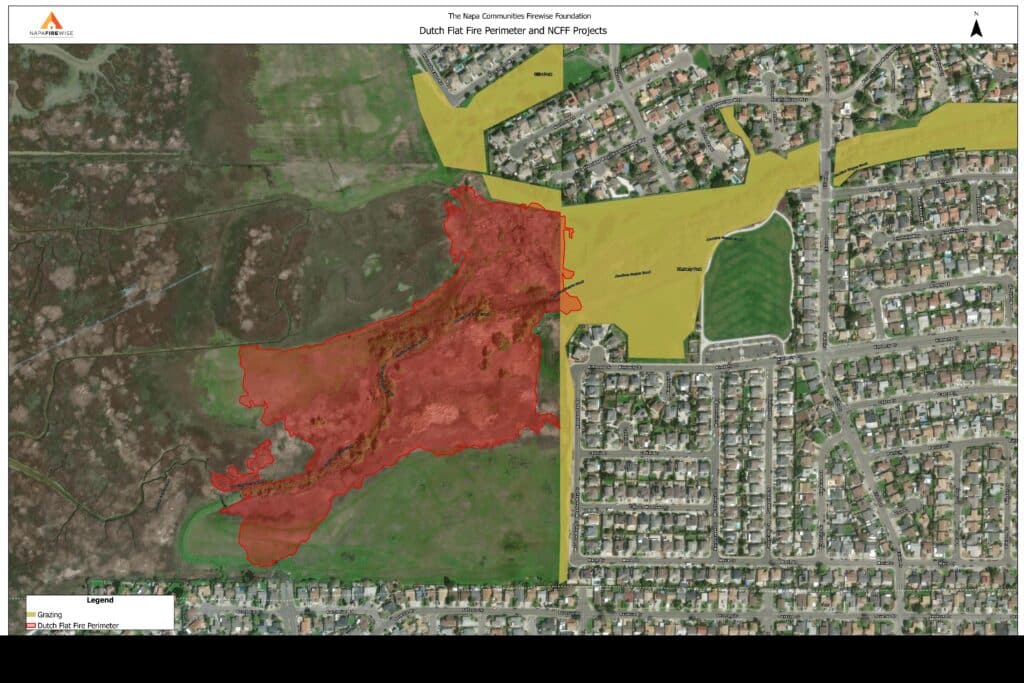
Grazing did not stop the Dutch Flat Fire. Firefighters did. What grazing did was change the conditions they arrived to.
Targeted grazing removes standing fuel, the cured grass that carries a fire fast and burns hot. Less fuel on the ground means lower flame lengths and lower intensity, and lower intensity means crews have somewhere to stand and work. The alternative is trying to hold a line in shoulder-high grass with homes directly behind you, which is not a line at all.
That is the entire mechanism. It isn’t dramatic, and it doesn’t photograph well. It shows up as a fire that ends at 32 acres instead of continuing into a subdivision.
How grass fires become structure fires
Here is the part worth sitting with, whether you live in American Canyon or anywhere else in Napa County.
The fires that destroy neighborhoods rarely arrive as a wall of flame out of a forest. They start in open space or wildland. They reach a handful of exposed homes, those with with poor defensible space, or little home hardening, and ignite.
And then the homes themselves become the fuel, spreading to their neighbors, growing in size with each new ignition.
Once that happens, the fire is no longer a vegetation fire. It’s a structure fire moving through a neighborhood, house to house, and vegetation management has nothing left to offer it.
Wind is the variable
American Canyon is no stranger to wind, and wind is what turns a manageable grass fire into an emergency.
In October 2021, the Newell Fire ran 150 acres in high wind and placed nearly 3,000 structures under evacuation warning. Like the Dutch Flat Fire, it reportedly began with a vehicle burning in a creek corridor.
Same city. Similar ignition. Very different day.
The difference between a 32-acre grass fire and a community-scale emergency is often nothing more than fuel and weather — and fuel is the only one of the two anybody gets to choose.
Why grazing is the right tool for this landscape
American Canyon’s terrain doesn’t look like the rest of Napa County. There are no steep forested ridgelines here. There are grassy wetlands, ground that equipment and hand crews struggle to reach, and neighborhoods that back directly onto open space.
Mechanical treatment is difficult in wet, soft, sensitive ground. Hand crews are slow across broad acreage. Livestock go where machines can’t, work on their own schedule, and leave the soil largely undisturbed — which matters in a landscape where protecting the wetland is a goal alongside reducing the fuel.
That’s why grazing has performed so well here.
The grazing visible across American Canyon since 2025 is a collaboration between the American Canyon Fire Protection District and the Napa Communities Firewise Foundation, funded by the County of Napa and the City of American Canyon. It builds on multi-year targeted grazing at the Newell Open Space Preserve, which reduces fuel loads while controlling invasive species and supporting watershed health.
What this means for your home
If your house backs onto open space, or sits three streets in from it, the Dutch Flat Fire is a reasonable example to think about as windy season arrives.
- Clear the first five feet.
- Nothing combustible against the structure. No bark mulch, no stacked firewood, no dry leaves in the gutter. This is the single highest-value hour you can spend.
- Harden the openings.
- Ember-resistant vents, screened gutters, nothing stored under the deck. Most homes are lost to embers, not flame fronts.
- Look at your fence.
- A wood fence attached to the house is a fuse leading to the siding.
- Sign up for ALERT Napa County and know your evacuation zone before you need it.
Napa Firewise’s Defensible Space Cost Share program reimburses eligible Napa County homeowners for defensible space work, up to 100% for income-qualified households, capped at $3,500. If you’d like to learn more visit our cost-share program page. Need help with your defensible space or know of a neighbor who could use support? Learn about Napa Firewise’s neighbors helping neighbors program.
Thank you:
Our thanks to everyone who turned out for the Dutch Flat Fire: the American Canyon Fire Protection District, Vallejo Fire Department, Napa County Fire (station coverage), CAL FIRE Sonoma-Lake-Napa Unit, American Canyon Police Department, and Fairfield Fire Department.
Thirty-two acres, evacuation orders lifted the same afternoon, and everyone home by dinner. That’s what a good day looks like.
As covered by
Napa Valley Register · July 25, 2026
American Canyon vegetation fire grows to more than 32 acres
Press Democrat · July 25, 2026
Evacuation orders lifted for Dutch Flat Fire near American Canyon