
Funded by: USDA Forest Service $1.5 million award, December 2022
Where: Hogback Ridge, along the Napa–Sonoma border above the Mt. Veeder area, west of Mt. Veeder Road near Mayacamas Vineyards
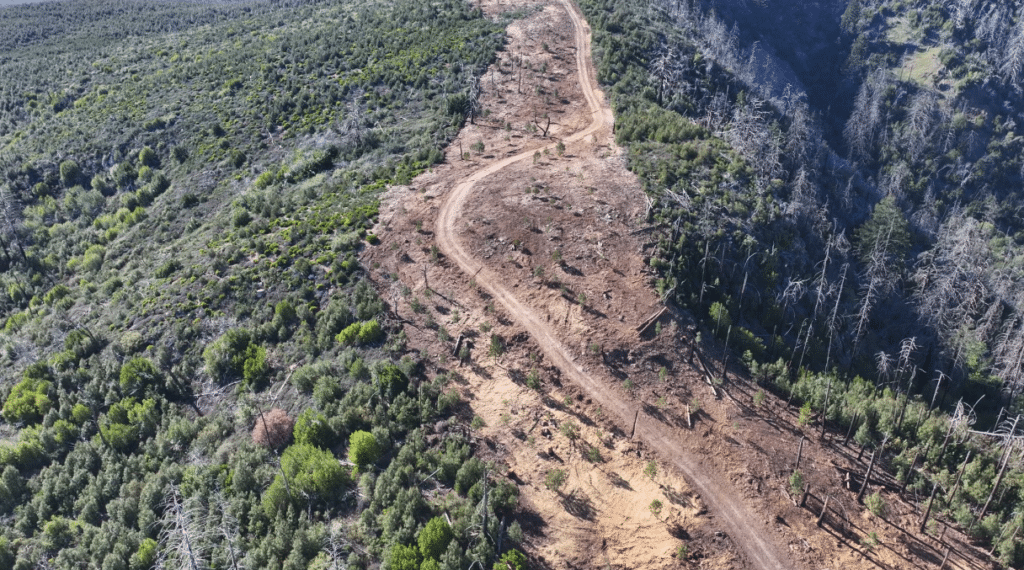
Scope: Approximately 11 miles of shaded fuel break, roughly 250 acres treated
Status: To be completed winter 2026
Partners: Mt. Veeder Fire Safe Council, Napa Valley Vintners, County of Napa, CAL FIRE, and conservation partners
About the Project
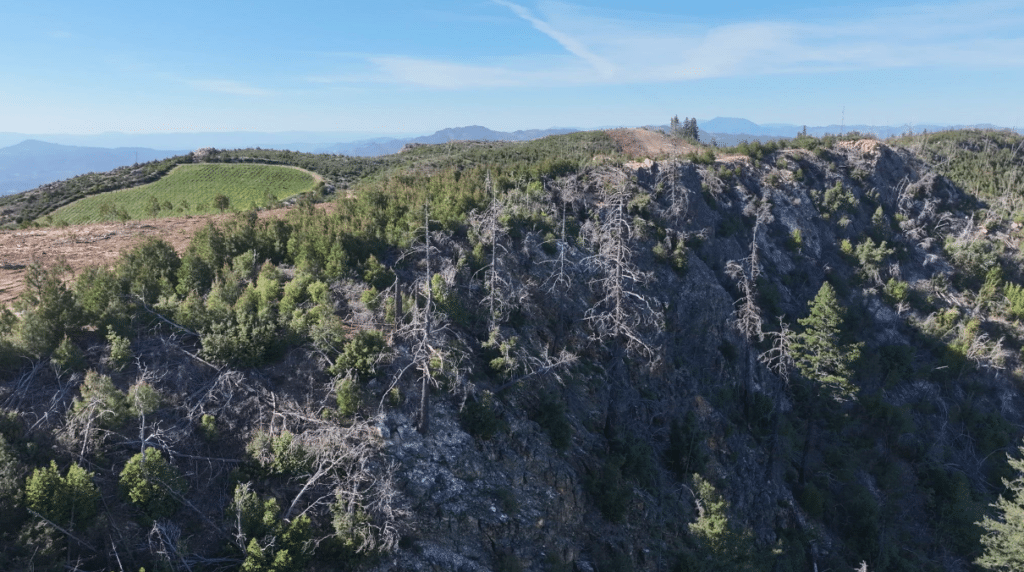
After more than a century of fire suppression and repeated major wildfires, a remote ridgeline along the Napa–Sonoma border has been reshaped to give firefighters something they rarely get: a safer place to stop a fire.
The Hogback Ridge Fuel Break is a land resilience project focused on restoring forest structure and reducing wildfire intensity along a critical corridor above Napa Valley communities. Designed with firefighter safety and ecological integrity in mind, the project treats the fuel break as one tool within a broader stewardship strategy, working with existing roads, vineyards, rock outcroppings, and natural barriers to guide the landscape toward healthier, fire-adapted conditions while minimizing vegetation removal.
The effort builds on years of prior mitigation work in the Mt. Veeder area. Former U.S. Senator Dianne Feinstein played a key role in helping secure the federal funding.
A Landscape Shaped by Fire — and Fire Absence
The Mt. Veeder area has experienced repeated large fires, including the 1964 Nuns Canyon Fire, the 1996 PG&E Fire, and the 2017 Nuns Fire. Since 2017, Hogback Ridge saw a rapid buildup of fuels, including accumulated dead debris and dense post-fire regeneration of knobcone pine, increasing ladder fuels and fuel continuity across the corridor.
Compounding the risk, more than 150 years of fire suppression and the historic removal of large conifers during early settlement left the ridgeline choked with brush and encroaching Douglas fir — a landscape primed for high-intensity fire behavior.
“This project is about correcting course,” said Mike Wilson, Napa Firewise Director of Land Resilience. “We’re using fire science, forest ecology, and hard-earned operational experience to restore a landscape that can better coexist with fire.”
How the Work Was Done
Crews applied a combination of hand work, mechanical treatments, pile burning, and targeted invasive species removal, including French broom. Restoration emphasized native vegetation, soil health, and wildlife habitat, so the land remains both fire-adapted and ecologically resilient.
Designed for Firefighters Before the Fire Starts
Fuel breaks and fire roads are critical during wildfire response, giving firefighters access, anchor points, and safer places to work. Ridgelines like Hogback Ridge often serve as natural containment lines, where reduced fuel loads and topography can slow or stop an advancing fire.
Pre-fire mitigation doesn’t eliminate the need for dozer operations during an active incident, but it significantly reduces the most dangerous work and improves firefighter safety. Opening the canopy also improves the effectiveness of aerial retardant drops.
“Projects like Hogback Ridge give firefighters a fighting chance,” said JC Greenberg of CAL FIRE. The August 2025 Pickett Fire demonstrated how proactive fuel reduction can directly improve suppression outcomes and operational safety.
Part of a Regional Line of Defense
Hogback Ridge is one piece of a long-term strategy to connect individual treatments into a coordinated system of defense along the Napa–Sonoma border. Napa Firewise aims to link this project north to Diamond Mountain, integrating multiple fuel reduction efforts into a defensible corridor spanning roughly 25 miles.
Countywide, through grant and donor support, Napa Firewise has treated more than 5,000 acres across 250+ funded projects, creating a growing network of fuel breaks and fire-adapted forests that protect homes, open space, and critical infrastructure.
“This is about stewardship at scale,” said Joseph Nordlinger, CEO of Napa Firewise. “The work doesn’t end when the equipment leaves. It’s about building landscapes that are safer, healthier, and more resilient for decades to come.”
What’s Next
A fuel break only does its job if it stays open. Maintenance of the Hogback Ridge corridor, and extending the line toward Diamond Mountain, are the next phases of this work.
This project is supported by the U.S. Department of Agriculture (USDA), Forest Service under Grant/Agreement 23-DG-11052012-184. Any opinions, findings, conclusions, or recommendations expressed are those of the author(s) and do not necessarily reflect the views of the USDA.